In the industry, most criminal record database vendors use the venerable but trustworthy FUD tactic. Standing for Fear, Uncertainty, and Doubt, they make you fear that they might have data other providers don’t. They make you uncertain of how you can reliably ascertain this, and they try to make you doubt your existing provider.
They also like to play the statistics game. As Mark Twain was fond of saying, “There are three kinds of lies : lines, damned lies, and statistics”. With a twinkle in their eye, they ask “so. How many records in THEIR data”? Seems like a good question, right? Him with the most records wins? Maybe if all records were created equal. But one common buyers remorse complaint in criminal records is “why, oh why, are there so many duplicates? Can’t you clean up your data”? LOL. If they cleaned up their data, they wouldn’t have the largest record count.
What’s the next one? “How many jurisdictions” seems like a good question. But again, what does it mean? One person listes “NC” as a jurisdiction. Another lists every county in NC. And then someone has this county they count as a jurisdiction that they have 73 records from. From 15 years ago. Where did they get them? Maybe from a court runner? How complete is that information?
What’s next? Here’s something we tried to do at Accio Data : You find people who found records at one vendor but not at another. But guess what we found out? The records that the “other vendor” didn’t have? Several interesting things :
Turns out the other vendor DID have them. It was differences in profiles/how filtering happened
Turns out the other vendor DID have them. But the other vendor’s search engine didn’t look at AKA’s. In this case, a search was run for the fictitional Adam Badboy. Adam was a registered sex offender. In the sexoffender registry, he was listed as having a primary name of Andy Badboy. And an alias of Adam Badboy. You sure would think that when you sent the vendor a primary name of Adam they’d check all of the names. They didn’t. takeaway : The search engine is at least as important as the data.
The other vendor didn’t have them. Turns out the record was expunged but one of the vendors wanted record count.
The other vendor didn’t have them. But they also had records that the first didn’t. Because no two databases are alike.
So back to the question of how to compare vendors? Run searches that have hundreds of records from both, put them in spreadsheets, and try to compare them? You’ll spend a LOT of hours accomplishing very little. Believe me. We tried it. It wasn’t fun.
And then I was talking to a client about the problem and they said the most prophetic thing : We vet our vendors by SALTING them. Just like we do county criminal searches. If we get back the same answer on our final report from both vendors, they’re equivalent. If we don’t, we investigate. What does the same answer mean? The same answer means that you added the same jurisdictions when processing in either database. Or if you added more jurisdictions from one of the databases, the end result of the county search was the same (which would likely mean the criminal database had stale or expunged information).
What if you do this and they’re not the same? Then you have to figure out why. Could be data deficiencies, different filter settings, different vendor software capabilities, or any number of other things.
So that’s how I recommend you do it. When evaluting a new MJD vendor, salt them. In Accio Data, it’s as easy as listing your potential new vendor as a salting vendor and putting in the percentage of searches that you want to salt with them.
About the Author
Barry Boes, CEO of Accio Data, has more than 30 years of experience providing solutions to consumer reporting agencies. Since childhood, he’s been fascinated by high performance, easy to use software and the productivity improvements they bring to their users.
I spend a lot of money on credit cards. Often $20K/month, sometimes much more. And I always pay them off in full every month – well, except during my divorce in Hays county, TX. But that’s another (long) story.
I spend a lot of money on business travel, and I fly on Delta a lot. I got offered a Delta AMEX business card that had a $650 annual fee, but it had great benefits. I have never had a card with annual fees, but the benefits on this card would make it worth it for the business. But only if I could spend enough on it. Spending enough would require a credit limit of at least $30K. That’s $15K a month in travel, but with credit cards you need a limit greater than your monthly spend because of the time it takes you to get the bill and for the bill to get paid. My company’s accounts pay bills the last day they can, so the credit limit needs to be about twice the monthly spend. My company agreed that getting the card made sense.
So I applied for the card. I asked for a $50K credit limit, and I made a notation that the card wouldn’t be usable to me with a credit limit of less than $30K and I instructed them to not issue me a card unless the credit limit was at least $30K.
On the application, they wouldn’t let me enter my business mailing address for invoices. They insisted on a physical address. All other AMEX cards the business has are sent to the PO box. And mail isn’t deliverable to the business’ physical address. So, after sending the application, I sent a message to AMEX via their secure messaging system notifying them that invoices would have to be sent to the PO Box.
Some time later, I received the business card. I activated it and used it once for a purchase around $400 to be sure it worked and set it aside to use for business travel.
A couple of months later, my PERSONAL AMEX cards got frozen. All of them. I logged onto the AMEX site and it showed that the BUSINESS card was late. Strike one. AMEX’ forced mixing of personal and business cards wasn’t pleasant. I’d had issues in the past where they misapplied personal payments and froze business cards and vice versa. AMEX also reported the late payment on the business card on my PERSONAL credit report and charged a late fee of about $150.
When I looked at the business card’s invoice, AMEX had ignored my message about the mailing address – a secure message I sent AMEX through their own system. They’d sent the bill to the business physical address and it (surprise, surprise) had been returned.
While I had the bill up, I saw that they’d sent the card with a $8500 credit limit. WHAT?! I specifically told them to NOT send me a card with a $650 annual fee with a credit limit of less than $30K because it would NOT pay off!
So I called AMEX. First, I tried getting the address fixed. AMEX insisted that it’s not possible for them to send bills to a PO Box. OK, that’s the only way my company (and many, many other companies) receive bills. Really? Yes, they said. Really. Not possible.
I pulled up a business AMEX bill for another card that had been sent to the business’ PO Box. I sent it to them. “Oh”, they said. “I need to talk to a manager”. Two hours of sitting with their Indian call center wasting my personal time later, they had the billing address sorted out.
All the while, AMEX aggressively demanded that I pay the invoice. I asked them to remove the late fees because they mailed the invoice to an undeliverable address. They refused. I asked them to cancel the card and remove the $650 annual fee because they had sent me a card I specifically told them not to. They refused. They said that my use of the card was implicit approval of their terms and I was responsible.
They pissed me off. I paid the $400 or so for the one charge I made on the card. They demanded that I pay the rest, and I refused. I told them to cancel the card on the phone and they refused. They kept shunting me to different people who kept trying to talk me into keeping the card. I refused and told them to cancel the card and they flat refused to do so. After another three hours of my wasted time talking to their Indian call center, I hung up the phone and wrote them a letter telling them to cancel the card.
A month or so later, I received another bill. With another $150 late fee. They hadn’t canceled the card. I called them on the phone again. Finally got them to cancel the card. But they insisted I’d have to pay the $650 activation fee and over $400 in late fees and interest.
I told them I wasn’t going to do it, that they ignored my instructions to cancel the card and they needed to remove the second late fee because they didn’t cancel the card and the first late fee because they mailed the invoice to the wrong address. I reminded them that they sent me a card with an unusably low credit limit – I couldn’t buy a single ticket to some of my destinations with it’s credit limit.
I looked at my company’s AMEX spending. My company typically spent $50K a month with AMEX. I looked up how much AMEX gets paid for credit card transactions. It’s 2.5-3.5%. AMEX was making $1,250-$1,750 a month on my businesses credit card transactions. And I typically spent $20K/mo on my personal AMEX. That’s another $500-$700/month in revenue.
I told AMEX that if they didn’t remove this unreasonable charge, I was going to discontinue the use of all of my AMEX cards and I was going to ask my company to do the same. They were going to lose more money a month on their skim off the top fees than the total of my bill, even with the inappropriate late fees and interest. They still refused to let it go.
So I told my company about the experience and asked if they’d discontinue their use of AMEX. My company agreed. I paid off and discontinued the use of all of my AMEX cards and so did my company.
Then followed two years of AMEX calling my cellphone and trying to get me to pay. At first, I explained the situation and sent them letters. They didn’t care. They wanted me to pay.
So I told them I’d never pay and told them never to call my cellphone again. I wrote them a letter saying the same. For over a year, they continued harrassing me on my cellphone anyway. Each time I told them to never call me again, and I wrote them additional letters instructing them to not contact me again. They just kept calling.
Eventually, AMEX reported the $$ as unrecoverable on my credit report. It was a business card, but it wrecked my personal credit.
I’m now paying them off because they have the leverage – through credit reports – to force me to pay them.
AMEX has lost hundreds of thousands to millions of dollars in lifetime “skim off the top” money because neither I nor my employer will use them again.
And I caution anyone who reads this to carefully consider doing business with AMEX. I’ve never been treated like this by Visa or Mastercard banks. There have very rarely been issues, but there have been a couple of times over 30 years that an invoice or check has gotten lost in the mail or something was mailed to an old mailing address after a move. The handful of times it’s happened, they’ve graciously removed late fees or interest charges and we’ve moved on.
When I spoke to an attorney about my AMEX woes, they told me two things. First, this is typical AMEX. They don’t use AMEX and they tell their friends not to use AMEX. And second, my only recourse was to pay AMEX.
And that’s why neither I nor my company use AMEX. And I recommend that you don’t either.
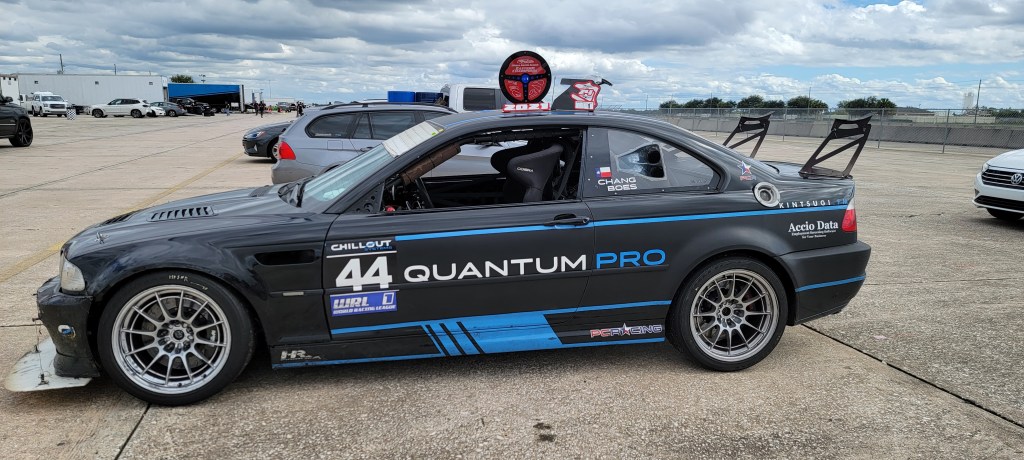
I’m sitting in a plane in Austin, TX waiting to depart to Orlando. When I arrive in Orlando, I’ll meet up with Colton Miller, my mechanic, and Darren Larsen, his helper, and we’ll head to Sebring, FL. We’re on the way to do something that’s never been done before – race 24 hours nonstop at Sebring International Raceway.
I’m driving for PC Racing in their #44 BMW. I was last in the car at Hallett a few weeks back, where Joe Bunton and I piloted the car to two wins in two back to back 8 hour races. Those wins propelled PC racing into the position of WRL GP1 West Coast champion.
This weekend will seal World Racing League’s East Coast championships. If we win this race, we also win the East Coast title.
I’m nervous. The driver lineup is still a little uncertain. Joe Bunton was going to drive with us. Then he got sick and was out. Rob Williams was going to drive with us. His father had a stroke and Rob is out. But Joe’s feeling good and has piloted himself and his wife down to Sebring in his private aircraft. We’ll meet up with him later.
I myself have been suffering from a cold – the first time in years that I’ve been sick. At 7AM I got a call from Peter Chang, the team’s owner : Rob’s dad has had a stroke. Joe is here and says he’s feeling 100%. I’ve also got Jay here. He’s a good driver, but he’s never driven Sebring and he’s never raced at night. I might need you in the car for 10 hours. Are you up to it or do I need to find another driver to fly in?
I told Peter I’ve got a cold but I’m feeling good. I’m pretty sure I’ll be able to do 10 hours in the car, but if I can’t I’m confident that Peter, an understated but very talented driver, will do just fine if he needs to drive. I don’t know anyone else we can bring in and know – with absolute certainty – that they can drive the car for two hours, make the lap times we need, and remain incident free. This is a 24 hour race. It counts as 3x the points of a normal race. We can’t go off. We can’t break down. We can’t get tangled up with another car. If we don’t finish, we can’t win. And finishing isn’t easy. I fully expect that 1/2 of the cars that start either won’t finish or will finish dozens of laps down due to car to car contact or off track excursions.
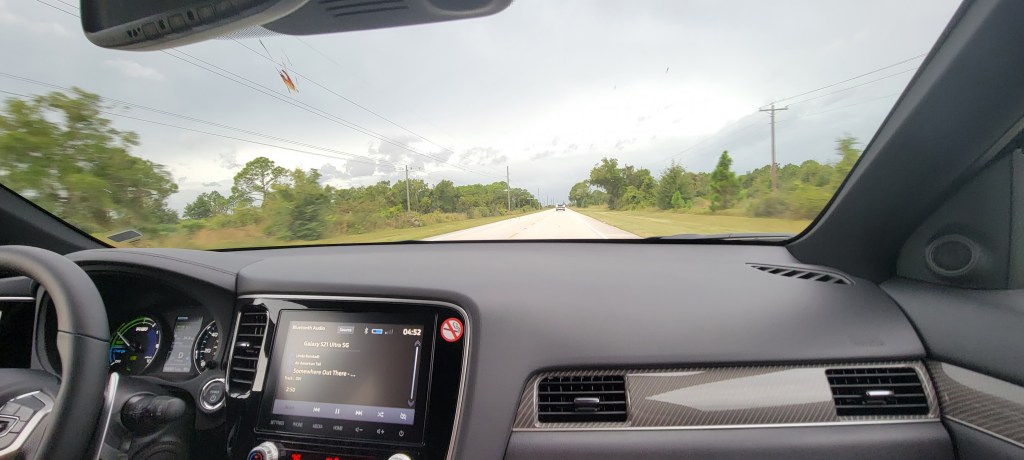
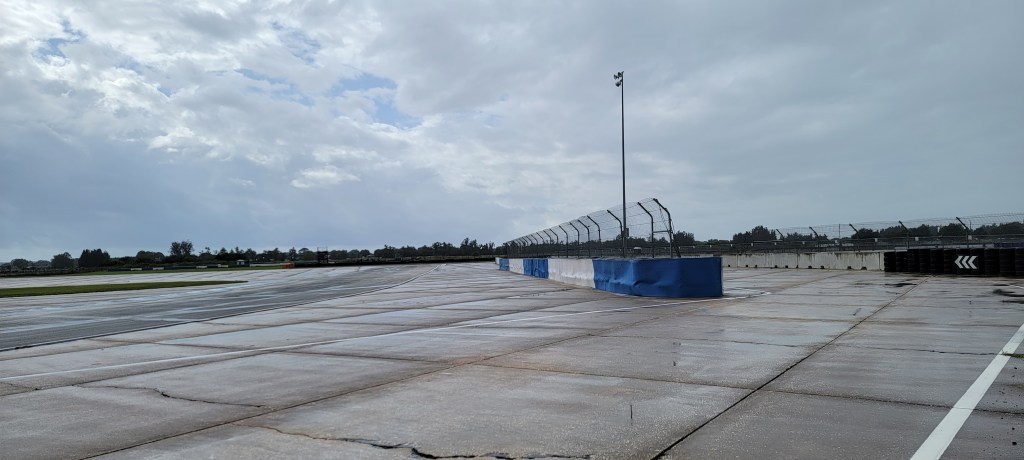
We picked up a PHEV Mitsubishi at MCO and we’re on the way to Sebring. It’s been raining on and off…
Looks like rain
I haven’t had the good fortune of racing in the rain for more than a year. Daytona rained some, but they mostly parked us for lightning. Last time I raced in a heavy downpour? Oh yeah, the WRL 14 hours of Sebring last year.
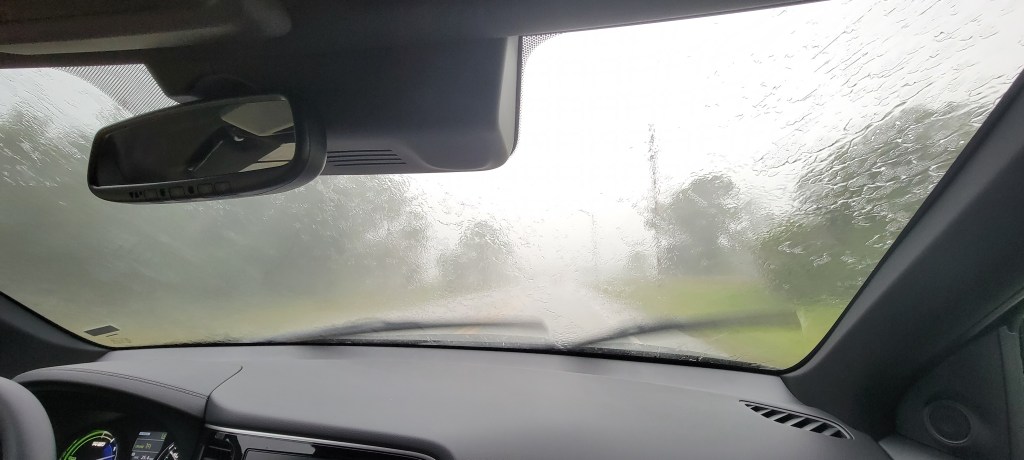
And here it comes. 7 minutes from the track.
Yep, rain.
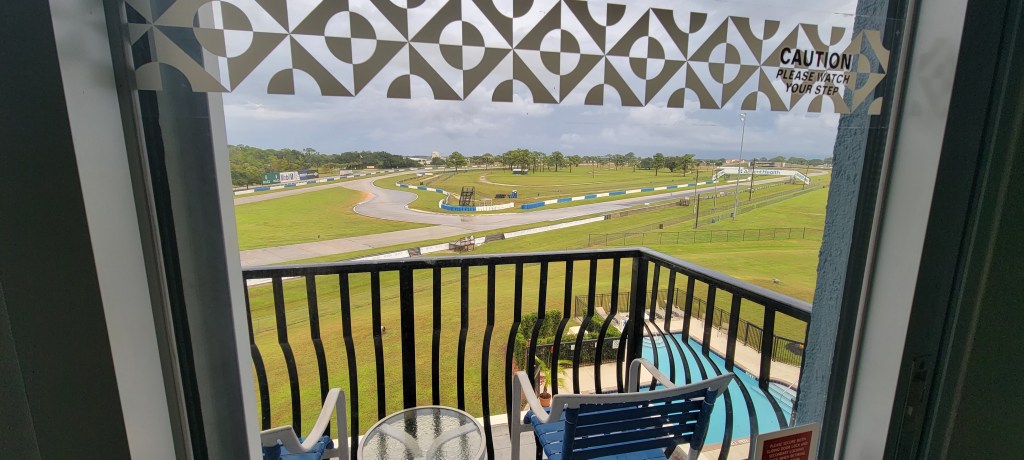
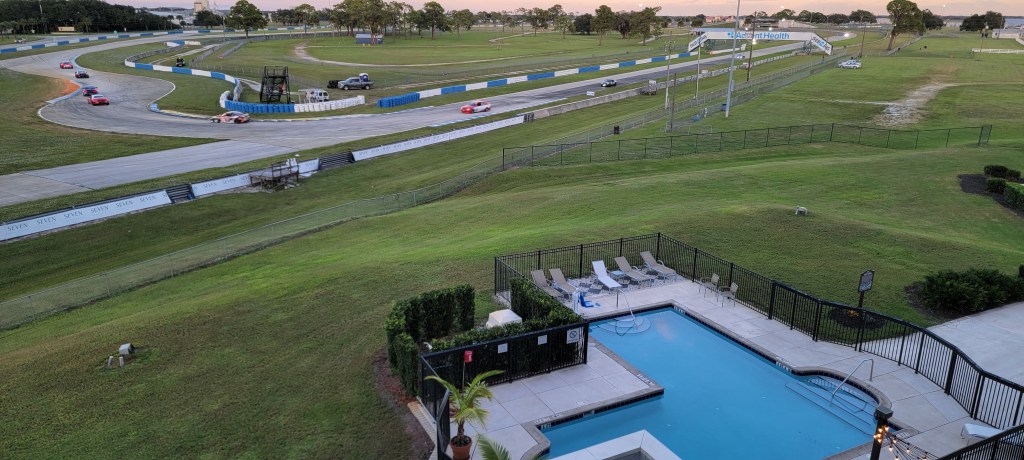
One thing I love about Sebring is staying st the 7 hotel. Named after turn 7, my room looks right over it.
Turn 7 from my room.
It’s Friday afternoon. Jay and Joe have been out and say the car’s good. We’re about to put stickers on and go out to do some spring testing and make setup tweaks for Sebring.
After the spring tweaks we’re happy with the car. Going up 50# and increasing the rear ride height balanced the car, and that was really important. We had a significant push at Hallett and we burned up tires horsing through it. Our tires should last much longer with this setup.
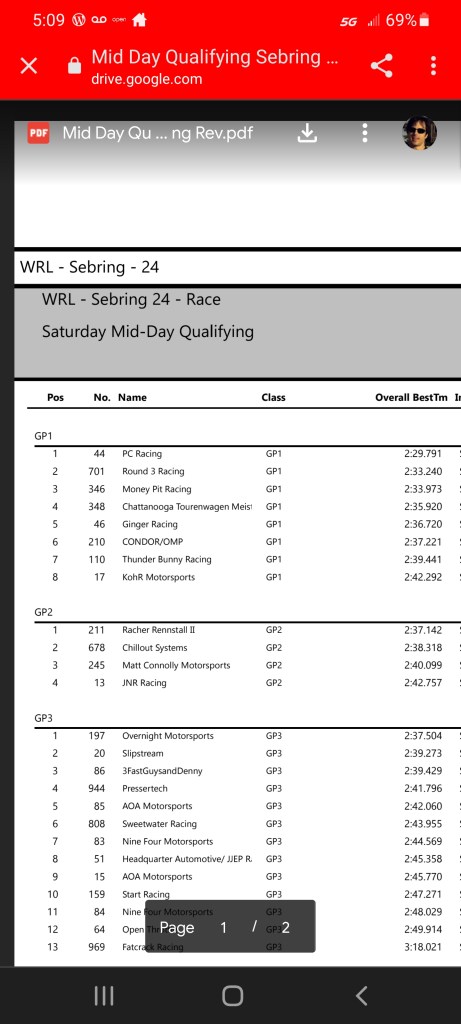
My only clean lap was before the spring change, but it was enough to put our PC Racing #44 BMW on pole by a very commanding 3.4 seconds.
I’m back at the hotel while others are getting their practice laps in. I wonder what the noise will be like as I catnap between my stints behind the wheel.
It’s ll AM. The race starts in an hour. And… it’s raining. I’m mentally preparing for starting a 24 hour race. In the rain. On a wet, green track.
We’ll have a soggy start.
I worked up a commanding lead at the start, building up to a 30 second gap to second place, when a full course caution came out in lap 10. I lost the gap I had, but was able to work it back up. Here at 2:45 into the race I’m out of the car and I handed it to Jay in the lead. Jay’s currently 14 seconds ahead of the #701 porsche in P2, and both cars just turned nearly identical lap times of about 2:31.5.
As dusk approaches, only about 35 of the 47 cars that started are on track. Some have retired permanently. Others have swarms of mechanics desperately working to get them back in the race.
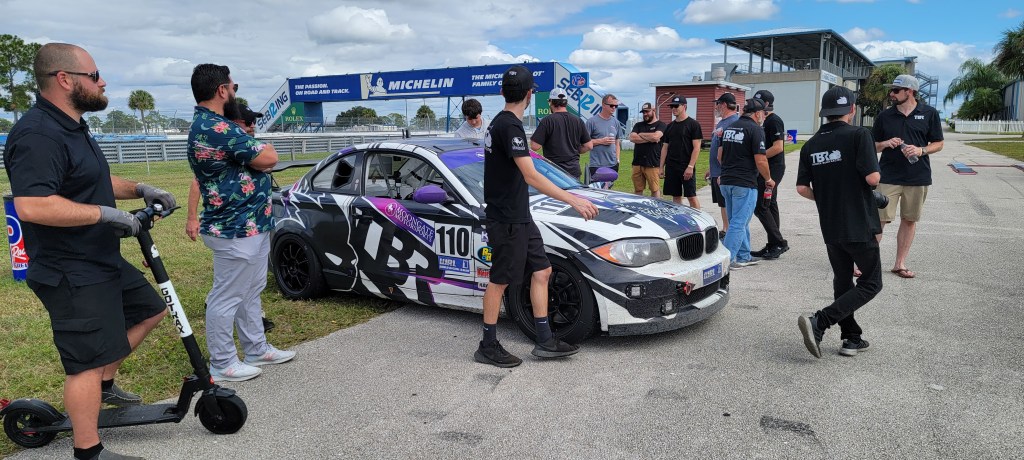
The #701 porsche, a hot contender of ours much of the season, is out for now. #346, Money Pit Racing, a car I haven’t seen before, was hauling ass and pressing us hard early in the race. Now they’re off the track, I don’t know why. #110, Thunder Bunny Racing, can be depended on to crank out lap after lap. They may not have the fastest car, but they’ll be there to nab you if you ness up. They keep their car running. They put fast. And they will slowly wear you down one consistent lap after another. Right now they’re in second place. We have 5 laps on them. It’s not a comfortable lead.
“What will we do about the leak”, I ask. “Nothing. Make sure it won’t lead to worse problems. We don’t have a spare exhaust. We need you to stay off the curbing and take it easy on the car”.
I’m back at our pit stall and ready for my next stint. My crew chief and mechanic told me we’re going to take 4 tires this stop – and investigate an exhaust leak we’ve developed.
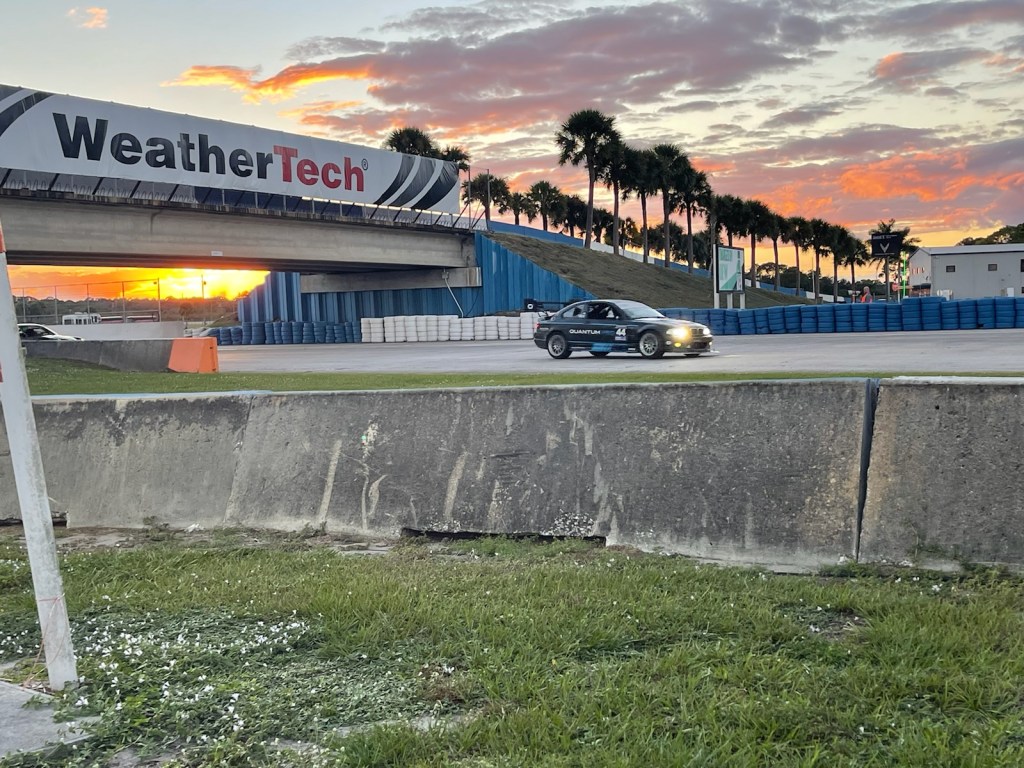
Darren Larson captured this fantastic dusk photo of us. We may have an exhaust leak, but at least we look good.
It’s 10:00pm and I just finished my second stint. I need to grab some sleep, I get back in the car at 2:40AM. When I got in the car, it felt down a little on power. I started short shifting to keep the revs under 7000 RPM in case the engine wasn’t feeling good. At the end of my stint, Peter told me the exhaust leak is causing the O2 sensor to read lean so it’s running the motor too rich. That explains the 15 or so horsepower loss I felt and the slightly worse fuel consumption.
About 2/3 of the way through my stint third gear became recalcitrant and wanted to grind. I stopped direct downshifts from 5-3, went through 4, and rev matched very carefully. That did the trick and it shifted smoothly for me for the remainder of my stint.
It’s only 79 degrees outside, but it feels plenty hot in the car. I need a shower before resting up for my next stint.
After Jay got back on track, we were still in first place and our margin to Thunder Bunny has grown to 6 1/2 laps.
At about 1AM, I saw that our car wasn’t making laps. Around 2:30 it was back on track. I made my way down to pit road to find out what was up and when they needed me. We were in a distant 3rd place, Thunder Bunny has 25 laps on us.
“The clutch throwout bearing went”, Peter said. “We got it replaced, but in the dark Darren hit the rear wing and broke a mount. I had to remove the wing”.
Oh boy. At the 14 hours of Daytona this year, we removed the rear wing as an experiment. It was not pretty. We picked up 8 mph on the oval and gained a second a lap. But the car was incredibly loose on the infield where we lost the second and more, but more importantly the car lost it’s ability to maneuver in traffic. It was dangerous to drive. I told Peter “I’m glad we tried this experiment. Let’s never do it again”. Well, I guess unless we have no choice but to park it or run without.
Also, the 701 Round 3 Racing Porsche, which broke earlier today, is now only 11 laps behind us. If they catch us we’ll fall off the podium. Their car is running great and their driver seems hell bent for leather. They’re running 2:29’s – faster than they went in qualifying – and we’re running 2:35’s.
We had a caution and did a slash and go with Joe in the car. I should get in around 4:10-4:20. I took a quick nap in the car, and when I returned to our pit the crew was getting some shut eye too.
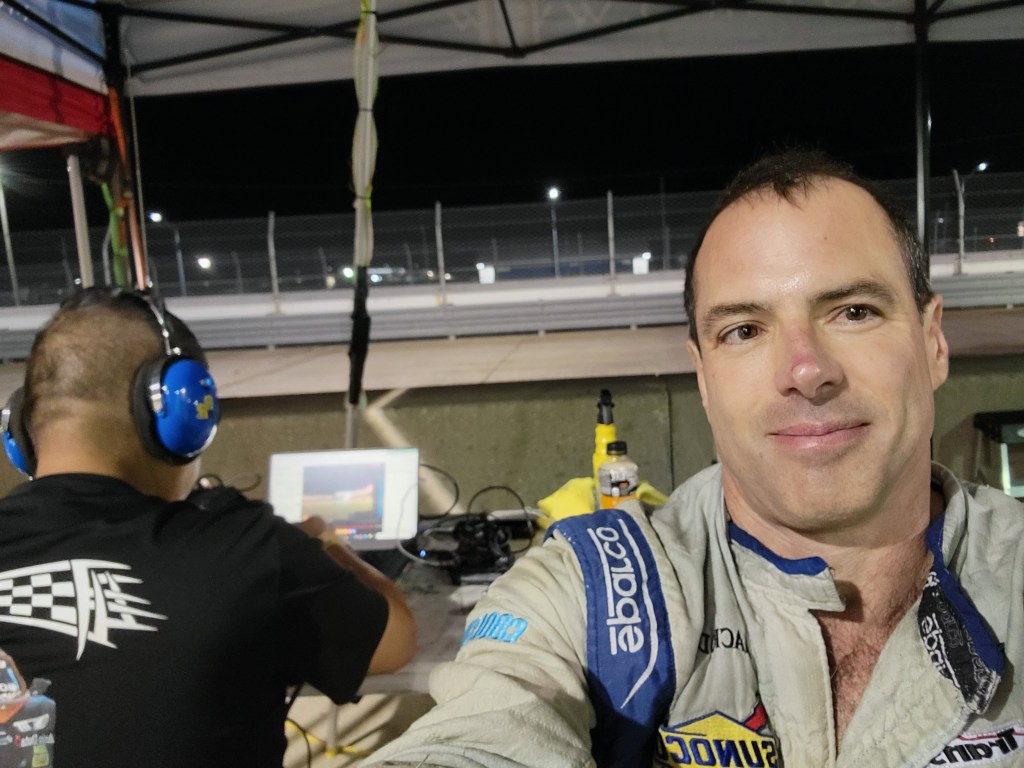
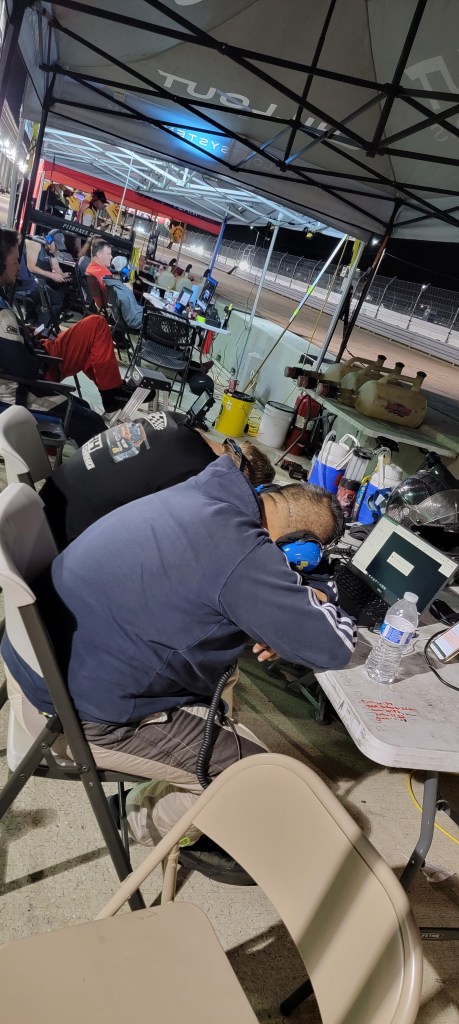
The crew gets some shut eye at 3:40AM.
These guys have been up since 7am yesterday doing final car prep and eating breakfast. And we still have more than 8 race hours to go. After that, with a little luck, we’ll need to go through tech on the way to the podium.
Wow! What a ride. For those of you who’ve driven an older Spec Racer Ford, it was kinda like that. Throttle on oversteer. Lift throttle oversteer. Can you say “needs fast hands”?
I’m just glad to get out of the car with it in one piece. Especially after the #701 round 3 Racing car sat on my tail gor 20 laps. The car and driver were seconds a lap faster than me, but he wouldn’t pass me even with a point by and a stab of the brakes. My guess was he was hoping to get in my head and let me take myself out rather than try to make up their 10 lap deficiency.
As I exited the car, we’re P2. #110 Thunder Bunny has a commanding 26 lap lead and #701 R3R is 10 laps behind us.
I got in the car for my last stint around 9:40 am. We were sitting in second place. Thunder Bunny was too many laps ahead to catch, but we needed to defend against 3rd and 4th. The wingless wonder was just as tail happy in the daylight as it was at night. But at least I could see what I might hit if I spun the car a lot better in the light.
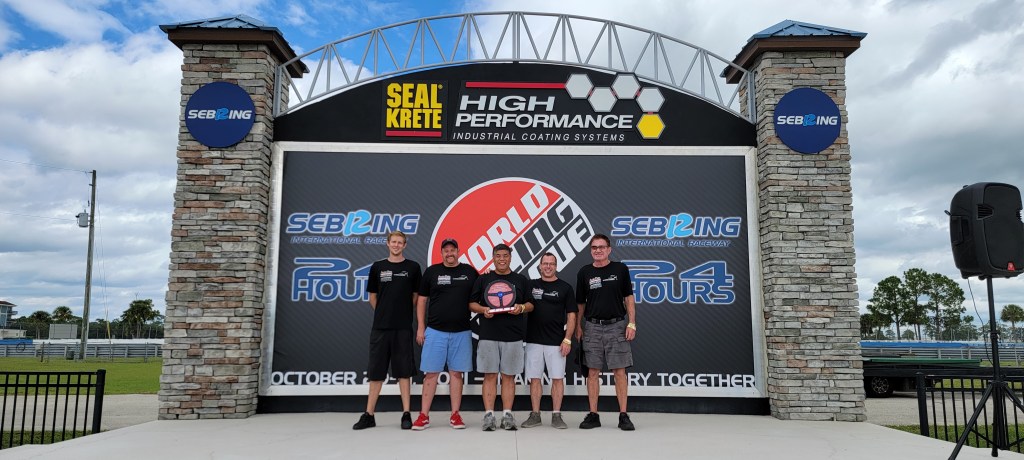
The race is over. We ended up P2 behind #110 Thunder Bunny, who were steady the whole race and didn’t break down. We finished ahead of the #702 R2R Porsche. They broke a left half shaft – twice.
Around 10:20 I got a “fuel pot low” light. Huh. That shouldn’t happen. I called it in. “Does it go off when you turn left? It could be the fuel transfer pump”. Me : “nope. Always on”. Pit road : “Probably a short, you can’t be low on fuel”.
Two laps later I got fuel starvation. “Come in for fuel”. I took on about 7 gallons. Back out. “Is the light going off”? “Nope. I think it’s the main fuel pump. I recommend replacing it”. “Agreed. Return to the Paddock”.
It was the main lift pump. We’ll be redesigning that part of our fuel system and adding redundancy before our next race. Colton got it replaced though, and we made it back out for the last 25 minutes of our 24 hour race.
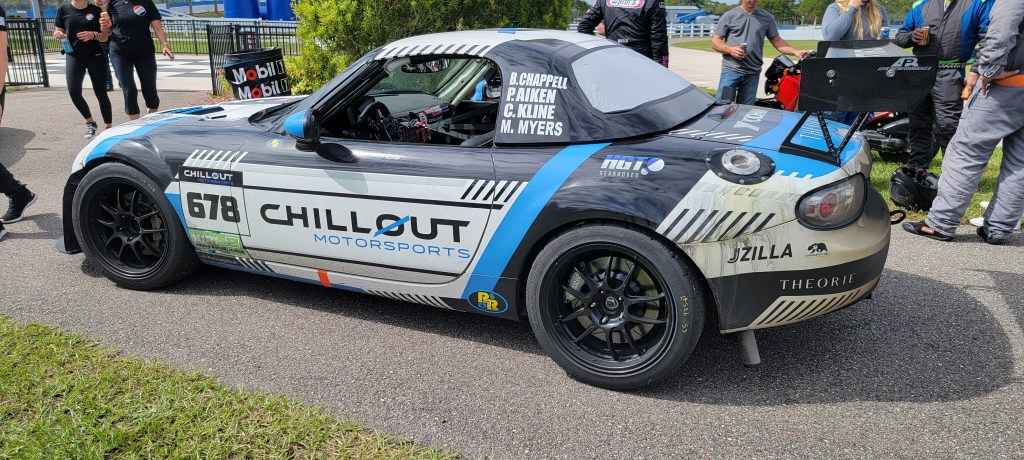
Thunder Bunny won our class – GP1My friend Charles Kline’s Chillout Miata won their class – GP2. I think they also get an award for “dirtiest car to finish”. Check out that rear bumper
While we came in second this race, we sealed the win of the 2021 Word Racing League East Coast Division champs.
Our car after the race
We started the race with a really nice race car. We ended the race with a worn out race car. One header is cracked. Our muffler is reportedly somewhere drivers left of turn 3. The transmission and differential are well used. The wing got ripped off on accident during the throwout bearijg replacement. On the bright side, the car has a nearly new clutch throwout bearing and main fuel pump. They failed and got replaced during the race.
At our last race at Hallett we won the 2021 WRL West Coast Division championships. Our next races are a double header at Circuit of the Americas. Two 8 hour races on Saturday and Sunday will determine whether we become the next national champions or not.
Between now and then, I get a chance to warm up on Circuit of the Americas with next weekend’s Trans Am race, where I’ll be piloting the blue #32 Accio Data/Sampson Racing Engines/ARX motorsports Ford Mustang.
I have purchased as a consumer two race car cooling systems – the RINI Personal Cooling Device, which I’ve had for about six months, and more recently the Quantum Cooler from Chillout Systems, which I’ve had for only a couple of weeks.
I have never purchased or used a water based cooling system for several reasons, click here to read them.
I’m going to jump right to the conclusions. Read more if you want details. Here goes : 95% of users should choose the Quantum Cooler. It’s 1/4 the cost and it has far more cooling capacity, but it is harder to set up and use than the RINI. Here’s a short summary of when you might want a RINI :
You want a RINI if :
Weight is an absolute priority
You have little space
Your car has very little (or no) power to spare
You need cooling for long races, but you don’t need a LOT of cooling. Think racing a Spec Miata, WRL or Champ-type car. Or pretty much anything at a NASA or SCCA race where the races are typically 20-30 minutes or less
Money is no issue at all – I paid over $8K for my system
You want a Quantum Cooler if :
You need LOTS of cooling. You’re especially sensitive to heat (like me) or you drive a really hot car like a Nascar or a Trans Am car or a Porsche Cup car. Or you live in Texas and regularly race in 100-105 degree heat
Available power is not an issue
Space is available
You can afford 12 lb of weight (the RINI weighs more like 7)
Money is available but not falling off trees – you’ll end up spending around $2500 for a complete system including the special shirt you’ll need to wear
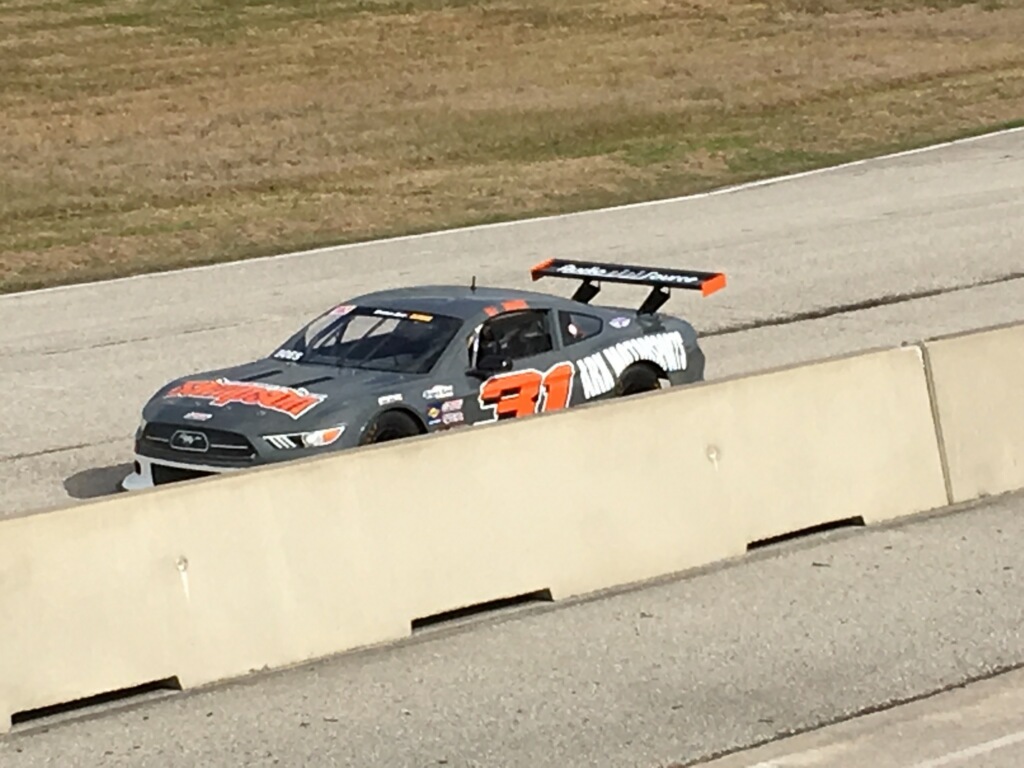
The grey #32 Howe Trans Am Ford-bodied TA2 car pictured to the left is the car I used to compare the performance of the two cooling systems. I ran both systems at the 2019 Trans Am race at Lime Rock Park. This car can be sweltering inside, getting as hot as 140 degrees F while racing. Under double yellow conditions the inside temps will climb an additional 20 degrees or so. I used the RINI for the test, practice, and qualifying sessions, each 20-30 minutes long. I used the Chillout system for the 70 minute race.
The difference in performance in a hot car was remarkable. The RINI kept me comfortable but warm on grid. On track, I would have overheated in the first lap without the RINI. With it, I was able to drive for about 20 minutes until my body temperature rose to the point that my performance began to decrease and my lap times increase.
On race day, the Chillout Quantum Cooler was remarkable. I didn’t have to run it for long at grid as we had a fan walk before the race, so we all got in our cars as they cleared the grid of fans. I set it for 40 degree water (knowing it probably couldn’t stay that cold during the race but wanting maximum performance) and hooked up. My mechanic had run the system in advance to pre-chill the water to 40 degrees. As the water mixed with the hot water in my coolshirt and hoses, the temperature increased to 80, mixed down to 72, and then the cooler started bringing the water temps lower. Water temp was about 50 when we started rolling.
During the race, the cooling system kept my body comfortable. I wear a Roux helmet with builtin plumbing for water cooling and I ran water from the QC to it as well. The Roux helmet never kept my head as cool as I’d like with the RINI, and the same was true with the quantum cooler. I’m not sure if they don’t allow enough water flow through the helmet or if the cooling hoses are located too far from my head, I’ll dig into that some other time.
The net effect was that I did some sweating, and partway through the race I started having trouble with water dripping into my eyes at a 45 degree angle when taking tighter turns. But even though we had only two double yellow laps the entire 70 minute race, and even though we were running at Lime Rock Park, which is perhaps the most physically demanding track I’ve ever raced on, I did not overheat. After the race, when I got out of the car, the crew was amazed. Usually after a Trans Am race every driver looks like hell. They’re hot, sweaty, tired, and need help getting unbuckled and pulled out of the car. Usually 20 minutes into a Trans Am race I’m wondering how it’s possible that the race isn’t almost over, and I’m wondering if I’ll make it to the end.
Not with the Quantum Cooler. With the QC, when my crew radioed in that the race was halfway over, I was amazed. Halfway already? I could do this all day! That’s the Quantum Cooler difference.
When I pulled into pit road after the race, one mechanic checked on the QC while the other checked my tires. While my rear tires were a bit overheated, the QC was not. The temperature gauge read 48 degrees and it was ticking away.
A note on temperatures : You will read all over the internet how cooling system manufacturers have determined that the optimum water temperature is 70 degrees, as at temperatures lower than this the water overcools the skin. This causes the capillaries in your skin to retract and decreases your body’s ability to release heat.
The above statement is true. However, what they don’t factor in is that, when you’re working your ass off driving a car, and when the water is being pumped through plastic hoses (plastic having horrible thermal transfer characteristics), the only time the plastic will actually reach 70 degrees is when either
The circulating water is 70 degrees and you’re sitting around doing nothing in a room temperature environment, or
The circulating water is 40 degrees and you’re working your ass off in a 140 degree oven.
My conclusion? Personal cooling devices used in race cars need to be able to generate water that is quite cold in order to overcome the extreme heat loads and the poor thermal transfer characteristics of the circulation hoses.
My car setup is pictured below :
The Rini isn’t installed in this photo, but you can see it’s mounting system to the left. The Rini is an engineering marvel and is physically no more than 1/4 the volume of the Quantum cooler. It also draws far less power, consuming at most about 80 watts (7 amps) when running full blast.
Both the Rini and the Quantum Cooler need cool intake air to perform acceptably. Running either system and allowing it to draw in hot air from the car will result in disappointment. I’ve tried passive outside air (a NACA duct to the cooling system’s intake) and forced outside air (through a bilge blower) with both systems.
Both perform dramatically better with passive outside air, but for the best performance forced air is a necessity.
About power draw and the Quantum Cooler – the Quantum Cooler will draw about 28 amps when at max cooling power, and in hot environments it spends most of it’s time here. This is a huge design consideration. Adding 28 amps to the alternator load on almost any race car will kill the alternator’s field at idle, meaning that the entire car and the cooler will be drawing from your battery. Car battery capacities are horribly misrepresented. A “30 AH” battery can only deliver about 3-6 AH of power before it’s voltage drops too low. For a car with 40 amps of ECU and fuel pump plus 28 amps for the QC, you’re looking at 68 amps. Your car’s battery can run that for at most 5 minutes before having problems. The Quantum Cooler doesn’t help this as it uses an internal 12-24V converter who’s capacity and efficiency drops remarkably as voltage from the battery dips, it will draw upwards of 40 amps if the battery voltage drops too low.
What this means is that, if you want to run the cooler while in the paddock or while on grid, you must either
keep the engine revved, watching voltage to make sure it remains above 13.5 (which lets you know the alternator is running, it’s field isn’t collapsed, and it’s powering the QC and charging your bateries), OR
power the QC from a separate battery source
In the picture above, you’ll see three 5 AH six cell 24v Lithium Polymer batteries to the right of the quantum cooler. This is my solution to running in the paddock and on grid. These batteries can run the QC for about an hour. Way more time than is needed to get from paddock to grid and wait to go out on track. Your mechanic can wire up the system so that you can switch it from the 24v batteries to the car’s 12v system when you’re ready to go on track, or (as I do) the mechanic can remove the batteries and plug you into 12v as you’re being released from grid.
A note on wiring : Wiring the RINI is simple. It’s 7A consumption can be run from almost anything, switched using any reasonable switch, and wired up using wire of any reasonable gauge. If you have a long run, 12 gauge wire would be best, but the system will function even with 15′ of wire run and using 16 gauge wire (not that you should, but it will function).
Wiring the Quantum Cooler is not as simple. If your run from the battery is short, you can use 10 gauge wire. For longer runs, you should use 8 gauge wire. And you cannot use just any old switch. You must use a relay, and not just any relay. To be safe, you need a 50A relay. If you’re careful to keep voltages up, you can get away with a 40A relay. If you only have 30A relays, you should use two in parallel. If you use adequate relays and wire, the system will reward you by performing extremely well. If you do not, you will think it’s junk and want to smash it with a hammer. Don’t do this. It’s not junk. If it doesn’t perform well, take it to an electrical system expert (think someone who installs high power car stereos) and get them to do the wiring for you. Your QC will reward you with incredible performance if you do.
A note on why I have never purchased or used a water based cooling system :
Everyone who uses them says they only work reasonably well if you use block ice. Creating block ice at a remote track or transporting block ice to a remote location is a challenge.
I’ve been told by many people that these systems work well when they’re full of ice but performance drops rapidly as the ice partially melts. I was told to expect only maybe 20 minutes of great performance. My experience with this type of cooling technology has been limited to medical systems using the exact same technology. I’ve had a couple of major surgeries (ACL repair and rotator cuff repair) who’s recovery involved weeks of use of a box with ice and water, a pump, and a cooling mat with serpentine hoses. My experience was as I’ve been told for the CoolShirt-type systems – There would be ice in the box for far longer than it would cool well. The cooling effect began dropping off noticeably when the ice melted even a little from “packed with ice” to “80% ice”.
The shirts supplied are clearly not reasonably functional. Look at them. Basically a 200′ long hose woven in the shirt. The water’s going to get warm a long time before finishing that route. Both Chillout and Rini provide shirts that run many hoses in parallel, and this is necessary to get reasonable flow rates and for the water to still be reasonably cool by the time it finishes winding through the shirt.
When I first started racing, I thought that a car catching fire was a very remote possibility. And exit should be easy, what’s the big deal? Do we really need fire suits? Do we really have to practice exiting our cars? Do we really need to practice exiting our cars blind?
Especially on cars with fuel cells and automatic fuel cutoff, what’s the big risk? I mean, a well maintained car’s never going to catch fire unless it’s horribly wrecked, right?
I found out the hard way (I’m unharmed) that well maintained cars regularly catch fire, that you really do need to be able to exit the vehicle blind, and that you really do need a fire suit in your cockpit.
I thought it might be helpful to outline some of the many very common reasons that race cars regularly catch fire, even when well maintained and not wrecked.
Reason #1 : Brake Fluid Burns
Brake fluid will auto-ignite if it contacts a surface above about 400 degrees C. Like exhaust pipes and brake rotors. But my car isn’t going to leak brake fluid, you say. How many production cars leak brake fluid and catch fire? Approximately zero? Negative one?
For production cars that don’t get raced, that’s mostly true. Take that car to the track, however, and all sorts of bad things happen. Brake rotors overheat, cook seals in the calipers, and then when you depress the brakes you spray brake fluid all over the calipers. The resultant fire is hot enough to catch plastic on fire. Or fiberglass. Or Carbon Fiber. Most modern cars have lots of that stuff under the front. Enough of it to burn the car to the ground if it’s not put out quickly. I’ve been in about 20 races in my life. All in cars that a mechanic checks for integrity before every race and which I go over carefully myself. And in those 20 races I’ve had one fire caused by leaking brake fluid. For me, that’s a 5% probability that when I get in a race car I’ll have a brake fluid fire.
Reason #2 : Oil Burns
But I have no leaks, you say. I have steel braided hoses, you say. Three very common ways that oil fires start are as follows :
Oil Fire Reason #1 : A gasket blows. Sometimes a crankcase can build up pressure, and a blown gasket around the oil pan will spurt oil out whenever you turn the car away from the side with a blown gasket.
Oil Fire Reason #2 : A cut hose. A friend tells the story of his Acura NSX with braided steel oil lines. He had it on track after a session with open wheel cars. He ran over a broken off carbon fiber bit, which sliced into his oil line like a knife.
Oil fire Reason #3 : A blown motor. Race long enough and a motor will let go on you. Maybe you miss a shift and overrev it. Maybe something just lets me go. In my 20 race career, I’ve had one blown motor. It was a brand new motor that I’d put about 15 track hours on. Parts tend to come flying out the sides of blown motors, and then oil spurts out after them (after all, the oil’s job was to lubricate those parts, wasn’t it)?
Oil fires will also catch fiberglass, plastic, rubber wiring, tires, and so on on fire and a small amount of oil can be enough to burn a car to the ground.
Here’s a video of me exiting a car after an oil fire caused by a motor that let go and oil sprayed onto my front right brake rotor. In the video, the concrete wall I’m next to looks orange. For some reason, you can’t see that it’s flame, but the wall looks orange because you’re looking through flames. Watch how fast my cockpit fills with smoke from a fire started by maybe 3 ounces of oil, which was enough to catch my fiberglass body on fire. Even though there was no fire in (or even very near) the cockpit, smoke still pours in fast.
It took me 18 seconds to exit the car. I’d practiced exiting this car in my mind many times, and I’d also recently practiced it in real life. And that 18 seconds started when I began to exit – it didn’t include the time I was driving/stopping a burning car.
Most of us wear SFI 3.2A/5 fire suits. One of these suits will give you 10 seconds from the application of flame to second degree burns. Gloves and socks and balaclavas give you far less time. Second degree burns are horrible. After my experience, it makes me wonder whether we should all be required to wear SFI 3.2A/15 suits.
The bottom line? If you race, expect that you will, sooner than later, have to exit a burning car. Practice timed exits regularly. Practice exiting from multiple locations (a door could be stuck shut or against a wall). Practice exiting blind. And practice holding your breath. In the video above, there was enough smoke that I was worried about lung damage from smoke inhalation. After radioing in that I was on fire, I held my breath until I was clear of my car.
And if you have anything plugged into yourself, ensure that it will release without your assistance. In the video above, you will see a black hose pull tight then pop away from me as I exit the car. That’s my RINI coolsuit system, and it’s connector is designed to release in this way in an emergency. Not all coolsuit connectors will do so.
Also check your radio or helmet cooling hoses. My radio plugged into my Stilo helmet, and it did not release when I started to run away from the car. I had to stop and manually disengage it. Not good, and it’s a problem I’ll fix for the future.
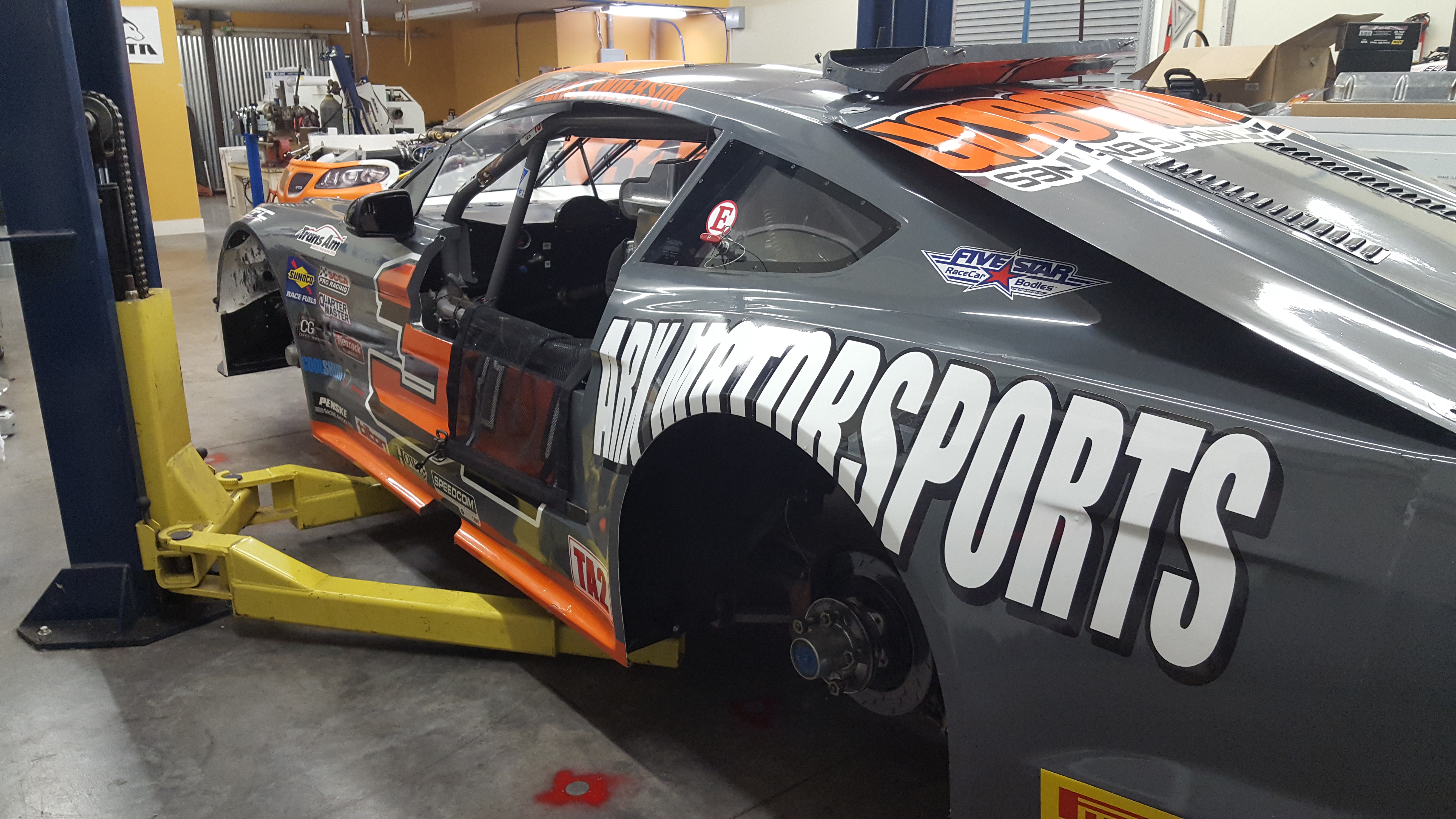
Yesterday I drove a Trans Am race car for the first time at MSR Houston. The car I drove is pictured to the left. What is it? It’s a TA2 car, meaning that it qualifies to race in Trans Am’s TA2 class. TA2 cars are built from the ground up to be race cars. It has a tube frame chassis, builtin fire suppression, electrical cutoff, and everything else needed to race a car. All cars in the TA2 class use a chassis provided by an authorized chassis supplier, such as Howe Enterprises or Mike Cope racing. The car I drove has a Howe chassis.
The cars get wrapped in fiberglass bodies. In the TA2 class, the bodies must be silhouettes of either a Dodge Challenger, Ford Mustang, or Chevrolet Camaro. Any of the three fiberglass bodies can be fitted to any chassis. There are three motors allowed as well – one from Dodge, one from Chevrolet, and one from Ford. And to “keep it real”, your fiberglass body must match your powerplant.
There are a couple of allowed transmission suppliers, but all transmissions must be four speed H-pattern dogbox transmissions.
So what’s it like to drive? After strapping in, securing the window net, and latching the doorsill (the car has “doors” that are just the top four inches or so of the area where a door would be, and they pop out), it’s time for get going. First, the master electrical cutofff is flipped on. Next comes the ECU and panel power switch. Next I put the gearbox into neutral and hit the power switch. Then things get visceral. Really, really visceral. This engine has no mufflers, and the side pipes exit the car right below your ears. The car is fuel injected, but after startup it’s not really obvious. It doesn’t want to idle, both because the ECU isn’t feeding it enough fuel to run cold and because of the large cam overlaps it runs. Warming up the motor means stepping on the gas pedal, which in turn means going even deafer than when the thing started in the first place.
Once the motor is up to operating temperature, it’s time to idle from the paddock and onto pit road. Wait, did I mention that 1st gear tops out at 90 and the car won’t run in gear below about 3,000 RPM? Doing the math, by the time you get the clutch fully engaged the car will be doing about 35-40 MPH. Not that fully engaging the clutch is easy. I’ve been warned that the car has a tiny 5.5″ clutch disk. It’s too weak to handle the stress of launching the car in a cloud of smoke, but it’s also too weak to be slipped overly much. “Make sure you don’t keep the clutch in for more than 3-4 seconds or you’ll severely shorten the life of the clutch throwout bearing”, I’m told. Also, “keep the tach at about 2500 RPM and slowly feed the clutch in until the car is rolling at speed”.
Let me translate all that. I killed the engine. Then I started it up and killed the engine. Then… well, you get the idea. The trick to getting the car rolling is to realize that the cams aren’t happy at 2500 RPM. Settle for keeping the motor surging between 2000 and 3000 RPM, then very, very carefully feed out clutch. Once the clutch is fully engaged, the car will start beating you up, lurching forward and pulling back as the engine tries to keep running at 2500 RPM. At this point you have two choices. If you can coast to where you’re going, push the clutch back in, put it in neutral, let the clutch out, and coast. If you can’t coast, feed in throttle while the car beats you silly. Don’t worry – once you get over about 3200 RPM the ride will smooth out. A little.
For my entire life, I’ve loved sportscars. And for most of my life, I’ve wanted to race cars. But how? I had no idea. Finally, in August of 2018, I found a way to race. It turns out that there’s a club race track near me. This club is kind of like a country club (except way, way, way less expensive). It has a race track. And it has an inexpensive racing series.
These guys understand that racing can be incredibly expensive. So they started a series racing first generation Miatas. 1989-1992 cars. The rules are strict to keep the cars safe and inexpensive — almost every component must remain stock. The car must have a roll
my antique race car – the #52 Miata
cage. The car must have a fire extinguisher or builtin extinguising system. You can start racing for well under $10,000.00 – $3500 or much less for a car, about $3K for a cage, and about $100 for a fire extinguisher and you’re ready to go racing. Since then I’ve found other inexpensive ways to race cars. Here’s my automobile racing history.
September 8, 2018 : Harris Hill Festival of speed. 2x 45 minute races.
September 29-30, 2018 : ChampCar double 8 enduro. One of three drivers in the 00 car on the “Two Beaners in a Bucket” team. We finished 12th day 1 and 22nd day 2. Both days I set the fastest lap time of the day in our car.
October 13, 2018 : Harris Hill Miata Challenge. 2x 45 minute races. Race 1 I finished 6th. Race 2 I finished 11th – I got black flagged for having three offs.
November 10, 2018 : Harris Hill Miata Challenge. 2x 45 minute races. Race 1 I started 13th and finished 6th. Race 2 I started 6th and finished 4th. Third place was Danny Soufi, last years’ NASA spec miata first place finisher. Running in Danny’s draft was an incredibly exhilirating experience.
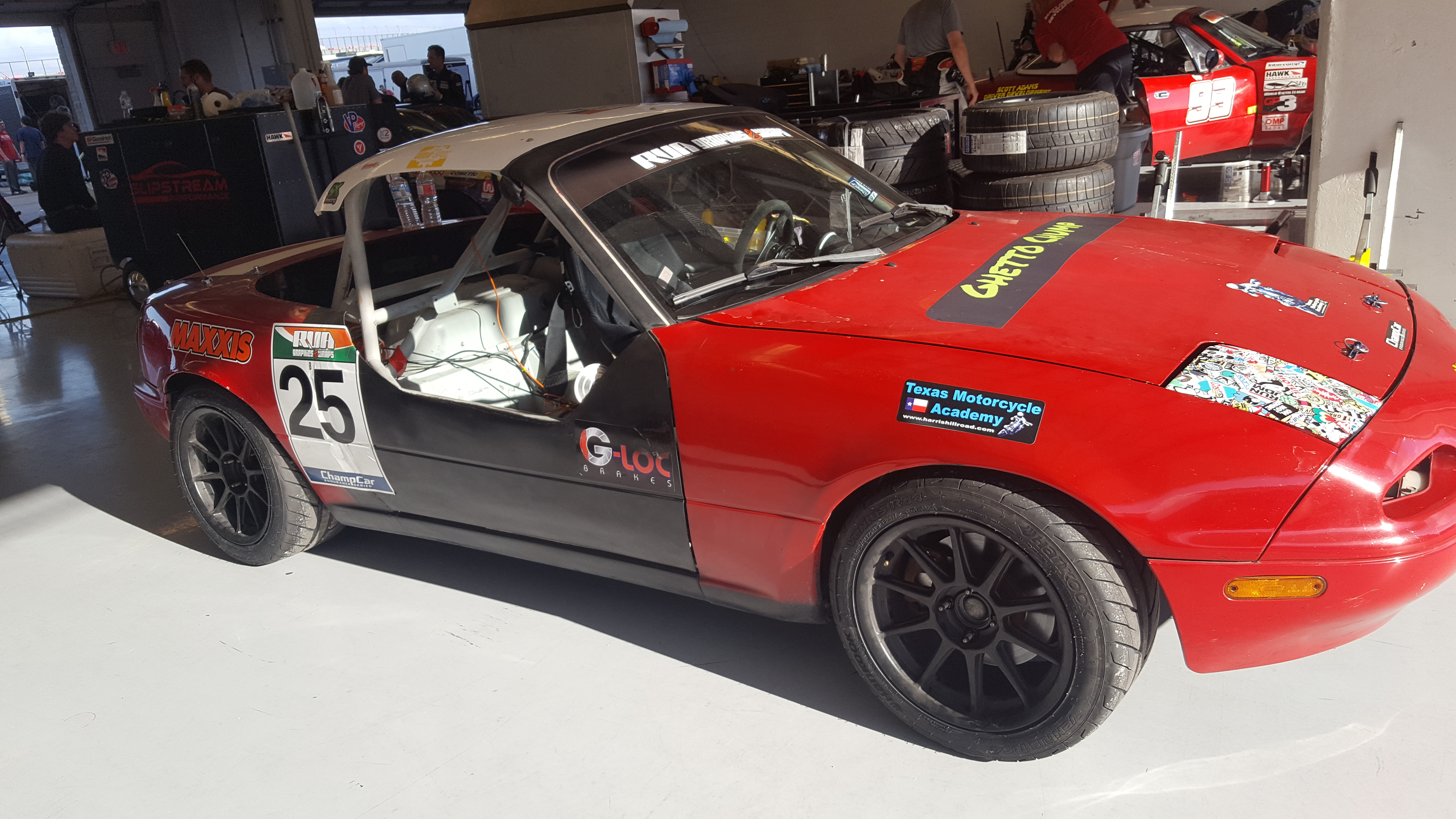
December 1-2, 2018 : WRL US National Championship double 8 enduro at the Circuit of the Americas. I bought into the Ghetto Chump car and got to race with the original Ghetto Chump crew – Sheldon, Grant, and Todd. We had lots of problems and didn’t finish our first day. Our first driver was Grant. The transponder didn’t work for him. We had to have him come in and it took more than 30 minutes to download software to my PC and get the transponder programmed. Then, on my stint, I hit a spun car coming out of 20. It wasn’t a hard hit, but our front wheels contacted and it jacked up our alignment. John Long with Auto-Spec loaned us parts and we got the car back on track for Todd, our third driver. Todd got in about 20 laps before the Mazda transmission to EcoTec motor adapter broke, and that was the end of our race.
December 8-9, 2018 : ChampCar 8+7 enduro at Barber Motorsports Park. I raced on the #00 “Two Beaners in a Bucket” team with Pete and Brian. This team has a reasonably competitive car, very good drivers, and everyone is fast in the pits and working on the car. But their goal is fair seat time over winning. So, for example, we have to change seats between drivers. Pete is a huge (not fat) guy. I’m tiny. And the seat doesn’t have a slider. Changing seats takes too much time for us to be competitive overall, so we compete for best lap time of the day and just see how we do. Day two we were in second place for almost an hour early in the day until our pit stops and some mechanical issues killed our chances at placing high. But we all laid down some very fast laps and had a great time despite the full time rain, huge standing puddles, and 40 degree weather.
December 15, 2018 : MSR Houston Spec Miata Winter Challenge. This race was put together at the last minute, but had some top SM drivers and some very fast cars.
I qualified horribly (I think 15th). My car ran well earlier in the day but it wouldn’t turn for qualifying and I was 2.5 seconds a lap slower than earlier in the day. We didn’t figure out the problem and I went from qualifying 13th place to finishing 8th. My second race we figured out that I had a [nearly] flat tire. All I had was stickers so I went out for the next race on a new set of tires. They were super slick for the first 8 minutes (of a 20 minute race), but once I got them scrubbed in and some heat into them I started running pretty fast, passed a couple of cars, and finished 6th.
December 29, 2018 : Bertil Roos Formula 2000 school race.
Qualified 1st.
1st place in race 1.
7th place in race 2. Led the 1st lap then had to pit 3 times due to engine issues.
This was my first race weekend as a NASA rookie. I ran in Spec Miata with a field size of 18. We had qualifying and two races both days. Races were 6-7 laps or about 13-14 minutes maximum green flag time. In practice we averaged 3-4 laps under green.
Saturday results :
Qualified : P3* (My transponder was broken and I had to start 18th)
Race 1 : Start 18th, finish 13th
Race 2 : Start 13th, finish 10th
Sunday results :
Qualified : P2
Race 1 : Start 2nd, finish 4th
Race 2 : Start 4th, finish 5th
February 9-10, 2019 : SCCA Majors – Hoosier Super Tour at Circuit of the Americas – GT2/TA2
Saturday : Qualified P2. Finished 1st in class, 2nd overall, 3rd fastest lap time
Sunday : Qualified P3. Finished 1st in class, 1st overall, fastest lap time, lapped most of the field.
March 1-3, 2019 : Trans Am TA2 pro race at Sebring


 The grey #32 Howe Trans Am Ford-bodied TA2 car pictured to the left is the car I used to compare the performance of the two cooling systems. I ran both systems at the 2019 Trans Am race at Lime Rock Park. This car can be sweltering inside, getting as hot as 140 degrees F while racing. Under double yellow conditions the inside temps will climb an additional 20 degrees or so. I used the RINI for the test, practice, and qualifying sessions, each 20-30 minutes long. I used the Chillout system for the 70 minute race.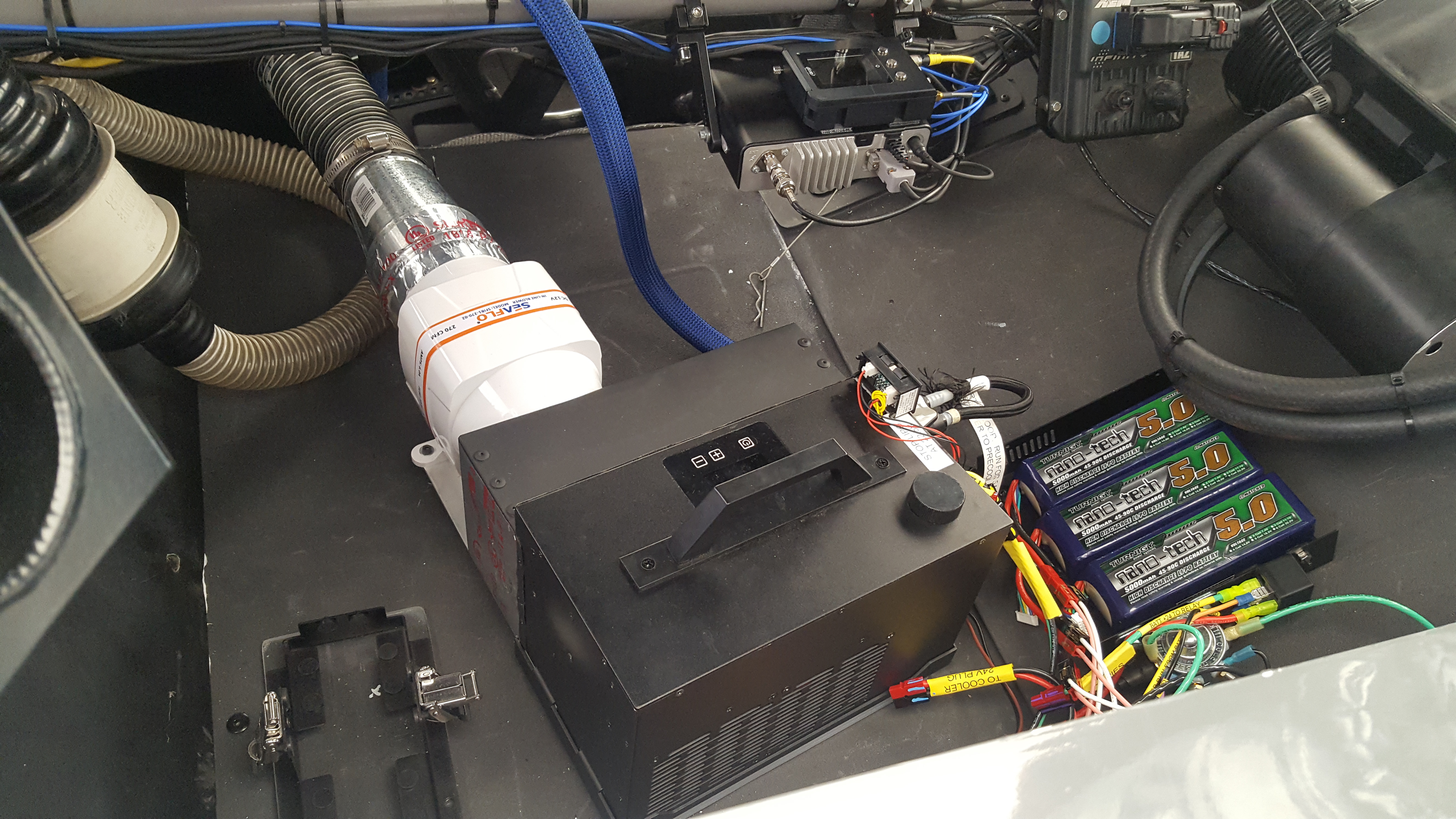
 Yesterday I drove a Trans Am race car for the first time at MSR Houston. The car I drove is pictured to the left. What is it? It’s a TA2 car, meaning that it qualifies to race in Trans Am’s TA2 class. TA2 cars are built from the ground up to be race cars. It has a tube frame chassis, builtin fire suppression, electrical cutoff, and everything else needed to race a car. All cars in the TA2 class use a chassis provided by an authorized chassis supplier, such as Howe Enterprises or Mike Cope racing. The car I drove has a Howe chassis.
 have him come in and it took more than 30 minutes to download software to my PC and get the transponder programmed. Then, on my stint, I hit a spun car coming out of 20. It wasn’t a hard hit, but our front wheels contacted and it jacked up our alignment. John Long with Auto-Spec loaned us parts and we got the car back on track for Todd, our third driver. Todd got in about 20 laps before the Mazda transmission to EcoTec motor adapter broke, and that was the end of our race.
 slider. Changing seats takes too much time for us to be competitive overall, so we compete for best lap time of the day and just see how we do. Day two we were in second place for almost an hour early in the day until our pit stops and some mechanical issues killed our chances at placing high. But we all laid down some very fast laps and had a great time despite the full time rain, huge standing puddles, and 40 degree weather.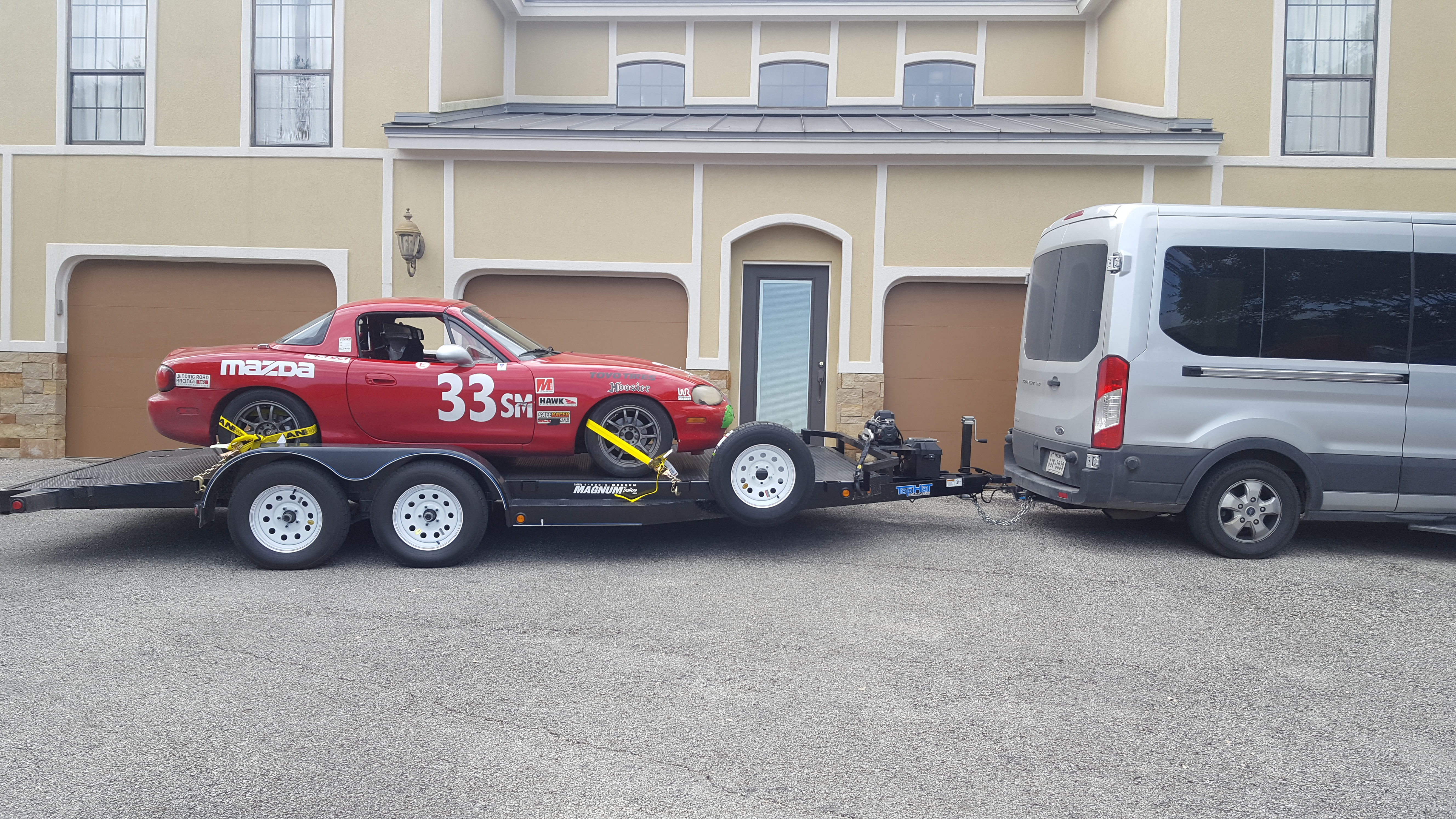

 Barry Races