
I have purchased as a consumer two race car cooling systems – the RINI Personal Cooling Device, which I’ve had for about six months, and more recently the Quantum Cooler from Chillout Systems, which I’ve had for only a couple of weeks.
I have never purchased or used a water based cooling system for several reasons, click here to read them.
I’m going to jump right to the conclusions. Read more if you want details. Here goes : 95% of users should choose the Quantum Cooler. It’s 1/4 the cost and it has far more cooling capacity, but it is harder to set up and use than the RINI. Here’s a short summary of when you might want a RINI :
You want a RINI if :
- Weight is an absolute priority
- You have little space
- Your car has very little (or no) power to spare
- You need cooling for long races, but you don’t need a LOT of cooling. Think racing a Spec Miata, WRL or Champ-type car. Or pretty much anything at a NASA or SCCA race where the races are typically 20-30 minutes or less
- Money is no issue at all – I paid over $8K for my system
You want a Quantum Cooler if :
- You need LOTS of cooling. You’re especially sensitive to heat (like me) or you drive a really hot car like a Nascar or a Trans Am car or a Porsche Cup car. Or you live in Texas and regularly race in 100-105 degree heat
- Available power is not an issue
- Space is available
- You can afford 12 lb of weight (the RINI weighs more like 7)
- Money is available but not falling off trees – you’ll end up spending around $2500 for a complete system including the special shirt you’ll need to wear
 The grey #32 Howe Trans Am Ford-bodied TA2 car pictured to the left is the car I used to compare the performance of the two cooling systems. I ran both systems at the 2019 Trans Am race at Lime Rock Park. This car can be sweltering inside, getting as hot as 140 degrees F while racing. Under double yellow conditions the inside temps will climb an additional 20 degrees or so. I used the RINI for the test, practice, and qualifying sessions, each 20-30 minutes long. I used the Chillout system for the 70 minute race.
The difference in performance in a hot car was remarkable. The RINI kept me comfortable but warm on grid. On track, I would have overheated in the first lap without the RINI. With it, I was able to drive for about 20 minutes until my body temperature rose to the point that my performance began to decrease and my lap times increase.
On race day, the Chillout Quantum Cooler was remarkable. I didn’t have to run it for long at grid as we had a fan walk before the race, so we all got in our cars as they cleared the grid of fans. I set it for 40 degree water (knowing it probably couldn’t stay that cold during the race but wanting maximum performance) and hooked up. My mechanic had run the system in advance to pre-chill the water to 40 degrees. As the water mixed with the hot water in my coolshirt and hoses, the temperature increased to 80, mixed down to 72, and then the cooler started bringing the water temps lower. Water temp was about 50 when we started rolling.
During the race, the cooling system kept my body comfortable. I wear a Roux helmet with builtin plumbing for water cooling and I ran water from the QC to it as well. The Roux helmet never kept my head as cool as I’d like with the RINI, and the same was true with the quantum cooler. I’m not sure if they don’t allow enough water flow through the helmet or if the cooling hoses are located too far from my head, I’ll dig into that some other time.
The net effect was that I did some sweating, and partway through the race I started having trouble with water dripping into my eyes at a 45 degree angle when taking tighter turns. But even though we had only two double yellow laps the entire 70 minute race, and even though we were running at Lime Rock Park, which is perhaps the most physically demanding track I’ve ever raced on, I did not overheat. After the race, when I got out of the car, the crew was amazed. Usually after a Trans Am race every driver looks like hell. They’re hot, sweaty, tired, and need help getting unbuckled and pulled out of the car. Usually 20 minutes into a Trans Am race I’m wondering how it’s possible that the race isn’t almost over, and I’m wondering if I’ll make it to the end.
Not with the Quantum Cooler. With the QC, when my crew radioed in that the race was halfway over, I was amazed. Halfway already? I could do this all day! That’s the Quantum Cooler difference.
When I pulled into pit road after the race, one mechanic checked on the QC while the other checked my tires. While my rear tires were a bit overheated, the QC was not. The temperature gauge read 48 degrees and it was ticking away.
A note on temperatures : You will read all over the internet how cooling system manufacturers have determined that the optimum water temperature is 70 degrees, as at temperatures lower than this the water overcools the skin. This causes the capillaries in your skin to retract and decreases your body’s ability to release heat.
The above statement is true. However, what they don’t factor in is that, when you’re working your ass off driving a car, and when the water is being pumped through plastic hoses (plastic having horrible thermal transfer characteristics), the only time the plastic will actually reach 70 degrees is when either
- The circulating water is 70 degrees and you’re sitting around doing nothing in a room temperature environment, or
- The circulating water is 40 degrees and you’re working your ass off in a 140 degree oven.
My conclusion? Personal cooling devices used in race cars need to be able to generate water that is quite cold in order to overcome the extreme heat loads and the poor thermal transfer characteristics of the circulation hoses.
My car setup is pictured below :
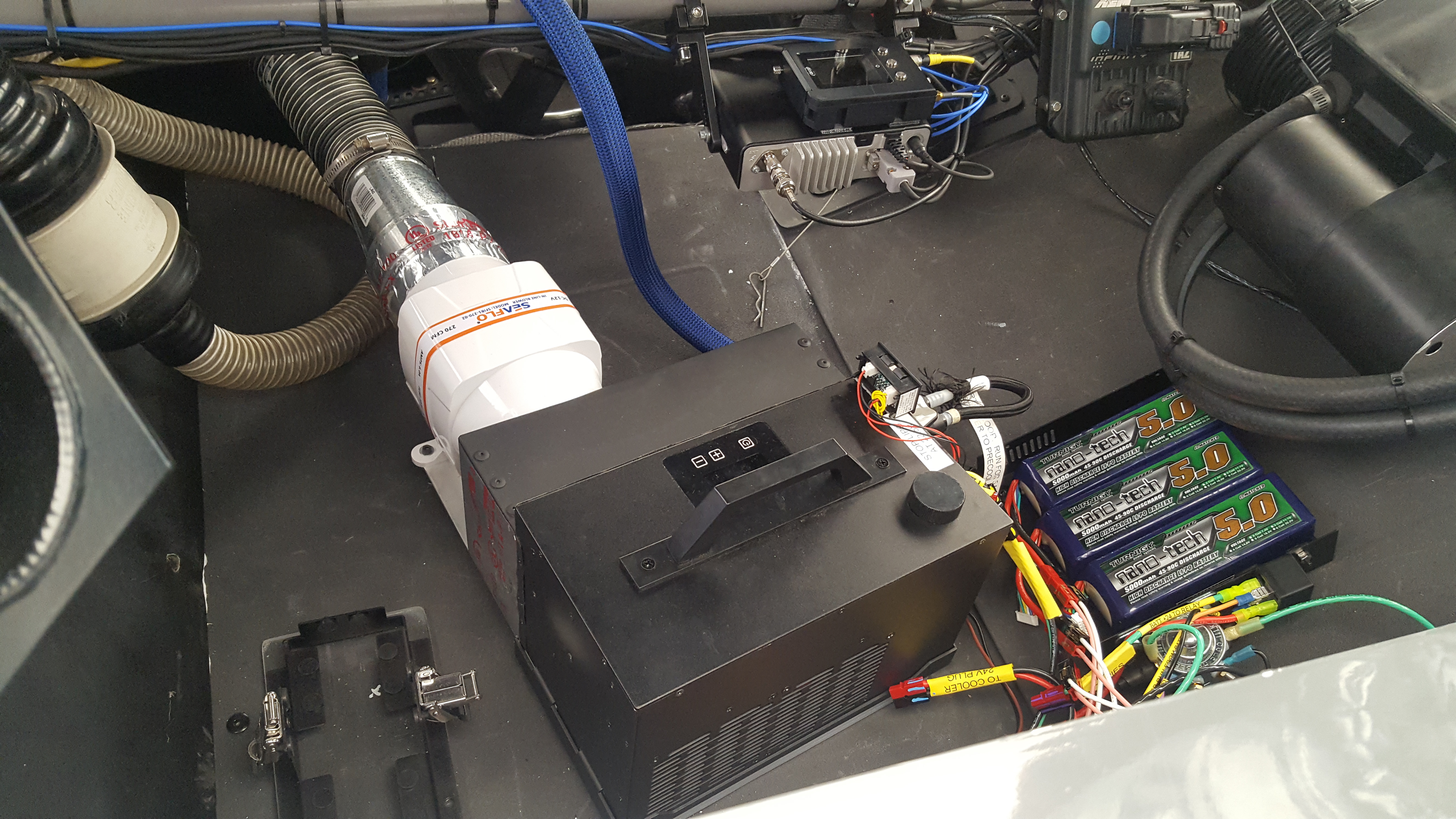
The Rini isn’t installed in this photo, but you can see it’s mounting system to the left. The Rini is an engineering marvel and is physically no more than 1/4 the volume of the Quantum cooler. It also draws far less power, consuming at most about 80 watts (7 amps) when running full blast.
Both the Rini and the Quantum Cooler need cool intake air to perform acceptably. Running either system and allowing it to draw in hot air from the car will result in disappointment. I’ve tried passive outside air (a NACA duct to the cooling system’s intake) and forced outside air (through a bilge blower) with both systems.
Both perform dramatically better with passive outside air, but for the best performance forced air is a necessity.
About power draw and the Quantum Cooler – the Quantum Cooler will draw about 28 amps when at max cooling power, and in hot environments it spends most of it’s time here. This is a huge design consideration. Adding 28 amps to the alternator load on almost any race car will kill the alternator’s field at idle, meaning that the entire car and the cooler will be drawing from your battery. Car battery capacities are horribly misrepresented. A “30 AH” battery can only deliver about 3-6 AH of power before it’s voltage drops too low. For a car with 40 amps of ECU and fuel pump plus 28 amps for the QC, you’re looking at 68 amps. Your car’s battery can run that for at most 5 minutes before having problems. The Quantum Cooler doesn’t help this as it uses an internal 12-24V converter who’s capacity and efficiency drops remarkably as voltage from the battery dips, it will draw upwards of 40 amps if the battery voltage drops too low.
What this means is that, if you want to run the cooler while in the paddock or while on grid, you must either
- keep the engine revved, watching voltage to make sure it remains above 13.5 (which lets you know the alternator is running, it’s field isn’t collapsed, and it’s powering the QC and charging your bateries), OR
- power the QC from a separate battery source
In the picture above, you’ll see three 5 AH six cell 24v Lithium Polymer batteries to the right of the quantum cooler. This is my solution to running in the paddock and on grid. These batteries can run the QC for about an hour. Way more time than is needed to get from paddock to grid and wait to go out on track. Your mechanic can wire up the system so that you can switch it from the 24v batteries to the car’s 12v system when you’re ready to go on track, or (as I do) the mechanic can remove the batteries and plug you into 12v as you’re being released from grid.
A note on wiring : Wiring the RINI is simple. It’s 7A consumption can be run from almost anything, switched using any reasonable switch, and wired up using wire of any reasonable gauge. If you have a long run, 12 gauge wire would be best, but the system will function even with 15′ of wire run and using 16 gauge wire (not that you should, but it will function).
Wiring the Quantum Cooler is not as simple. If your run from the battery is short, you can use 10 gauge wire. For longer runs, you should use 8 gauge wire. And you cannot use just any old switch. You must use a relay, and not just any relay. To be safe, you need a 50A relay. If you’re careful to keep voltages up, you can get away with a 40A relay. If you only have 30A relays, you should use two in parallel. If you use adequate relays and wire, the system will reward you by performing extremely well. If you do not, you will think it’s junk and want to smash it with a hammer. Don’t do this. It’s not junk. If it doesn’t perform well, take it to an electrical system expert (think someone who installs high power car stereos) and get them to do the wiring for you. Your QC will reward you with incredible performance if you do.
A note on why I have never purchased or used a water based cooling system :
- Everyone who uses them says they only work reasonably well if you use block ice. Creating block ice at a remote track or transporting block ice to a remote location is a challenge.
- I’ve been told by many people that these systems work well when they’re full of ice but performance drops rapidly as the ice partially melts. I was told to expect only maybe 20 minutes of great performance. My experience with this type of cooling technology has been limited to medical systems using the exact same technology. I’ve had a couple of major surgeries (ACL repair and rotator cuff repair) who’s recovery involved weeks of use of a box with ice and water, a pump, and a cooling mat with serpentine hoses. My experience was as I’ve been told for the CoolShirt-type systems – There would be ice in the box for far longer than it would cool well. The cooling effect began dropping off noticeably when the ice melted even a little from “packed with ice” to “80% ice”.
- The shirts supplied are clearly not reasonably functional. Look at them. Basically a 200′ long hose woven in the shirt. The water’s going to get warm a long time before finishing that route. Both Chillout and Rini provide shirts that run many hoses in parallel, and this is necessary to get reasonable flow rates and for the water to still be reasonably cool by the time it finishes winding through the shirt.
 Barry Races